Danjel’s decision to join the emigration
The EmigrantsDanjel’s decision to join the emigration converts religious persecution into a concrete departure, linking his own need for freedom of worship to the migration already planned by Karl Oskar Nilsson and his family. He arrives at Korpamoen in the night believing that God has directed him there, asks Karl Oskar’s help in reaching America, and brings nine people from Kärragärde into the emigrant party. The decision is both a declaration of faith and a sequence of practical arrangements: passage must be contracted, space secured, and people gathered for the road to Karlshamn.
Persecution and the call to leave
Danjel’s choice grows out of a conflict with the authorities over his religious practice. The dean had reconciled many Åkians with the church, but Danjel had not returned to what the authorities considered the right religion. After being cited and fined for preaching heresy, he continued holding Bible meetings and administering Communion in his home despite judgments against him. By the time he was summoned for a third offense, the expectation in the community was that he would be exiled. Emigration therefore offered more than a new home: it meant escape from a place where he believed he was prevented from confessing his God.
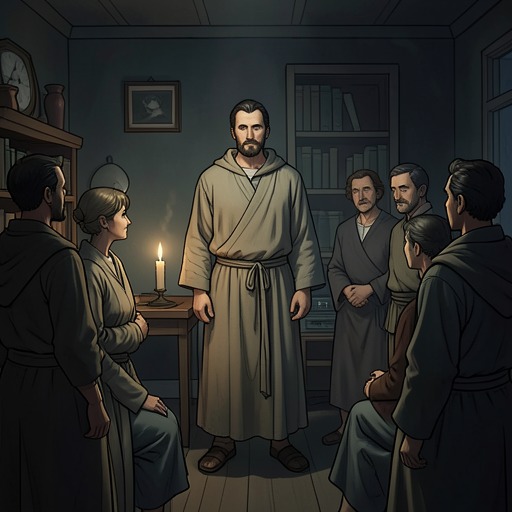
His decision enters the narrative as a nighttime visit. Karl Oskar and Kristina, awakened by a knock, initially have reason to fear that the sheriff has come for Robert, the runaway farmhand. Instead, the visitor is Danjel, whose calm manner makes his extraordinary message harder to dismiss as confusion. He tells them that the Lord awakened him and directed him to Korpamoen. The command he has read in Genesis—to leave his country and kindred for a land God will show him—becomes, in his understanding, a specific instruction to seek Karl Oskar’s help.
Danjel’s revelation also gives scriptural form to the broader unrest spreading through the peasant communities. News of fertile land in America has traveled by rumor, print, and neighborly report into villages accustomed to inherited routines. For Danjel, the movement from Sweden is not simply a response to material hardship or an attraction to distant land: he reads it as a divine summons. His conviction does not erase the practical uncertainty of the journey, but it gives that uncertainty a religious meaning and a direction.
From revelation to an arrangement for passage
Kristina recognizes Danjel as her uncle and receives the news with delight, asking whether he will accompany them to America. His answer makes the decision collective: he believes God has ordered that they move together, and that he will carry his faith with him. Kristina’s earlier fear that the unexpected visitor might be mad gives way to affection and reassurance. Danjel had been kind to her since childhood and had twice helped the couple with mortgage interest; his presence on the difficult voyage feels to her almost like having her own father travel with them.
The prospect of bringing Danjel’s followers complicates that welcome. Karl Oskar worries that their religious differences will cause inconvenience and trouble. Kristina, too, loses some of her enthusiasm when she learns that Ulrika of Västergöhl and her daughter Elin are to come. She doubts that Ulrika has truly become a different person and would prefer that her uncle not pay for her passage. The decision to emigrate thus exposes a tension between the promise of solidarity and the old social judgments the emigrants carry with them.
Danjel’s appeal meets a willing, materially grounded response. Karl Oskar is prepared to help whether or not God has commanded it: he owes Danjel for assistance with the farm loan and is ready to repay that debt. The household’s migration plans already have a route and a vessel. Karl Oskar and Robert have written to a firm in Karlshamn and paid one hundred daler toward passage for six people on the Charlotta, a merchant ship bound directly for New York. Spring is preferred so that the emigrants can arrive early enough to plant and harvest before winter. Robert is to write for Danjel and obtain a contract if the ship has room for more.
The request expands the proposed party substantially. Danjel estimates that nine people will travel from Kärragärde, including children and household members, and confirms that Arvid, his hired hand, is among them. Robert already knows that Arvid has been promised a place: the previous day Arvid had confided his master’s offer in exchange for secrecy and had wept with joy. The decision therefore connects the religious leader’s departure to the hopes of a farm servant as well as to the Nilsson family’s arrangements. A revelation in one household becomes a chain of commitments across several households.
Joining the road to Karlshamn
When the emigrants gather at Åkerby Junction, Danjel’s decision is visible in the composition of the party. He has hired a team from Kråkesjö and travels with his wife, four children, and Ulrika. Arvid and Elin, unable to fit on Danjel’s wagon, ride with Jonas Petter of Hästebäck; the travelers’ places in the wagons reflect the limits of transport as much as their shared destination. Robert moves to Jonas Petter’s wagon to lighten the crowded load from Korpamoen, where he sits beside Elin, while Arvid rides behind him. The two former farmhands from Nybacken are now traveling together toward the New World, though their departure is no longer the secret escape they once imagined.
There are nineteen people at the junction, including three drivers who will return from Karlshamn; sixteen are emigrants—nine adults and seven children. Danjel’s group has joined a party large enough to be described as a family, but one assembled from different motives and ties. The novel presents group emigration not as a single, uniform impulse: in this company, religious dissent, employment, family circumstances, and other personal pressures converge on the same route.
The road’s gates give Robert a small, recurring task that marks the party’s passage out of the familiar parish. He jumps down to open and count them, treating even the open gaps in winter pasture fences as gates on the road to America. Around him, the departure also registers as a loss of home: Karl Oskar and Kristina look back at the brook and meadow they are seeing for the last time. For Danjel, the road is the beginning of a land he believes God will open; for the whole party, it is a threshold between a known community and an uncertain crossing.
The decision’s reach
Danjel’s choice changes the scale and character of the emigration. It brings a group threatened with religious exile into an expedition already shaped by Karl Oskar’s search for a future beyond debt and diminishing prospects. It also draws in people who might otherwise have followed separate paths, including Arvid and Elin, and makes passage dependent on negotiation with a shipping firm and the availability of room aboard the Charlotta. Faith supplies Danjel’s explanation for leaving; kinship, past assistance, employment ties, and transport arrangements help make leaving possible.
The decision does not resolve the uncertainty that had troubled Kristina. She had doubted the unverified reports of American land and the lack of guarantees, while Karl Oskar believed the new country offered an escape from years of labor without improvement. Danjel’s certainty offers another kind of assurance, rooted not in a deed or promise from American authorities but in his belief that God has directed the journey. When the Charlotta’s passengers later endure illness, confinement, and hardship, the difference between promised destination and difficult passage becomes stark. Yet the initial choice remains decisive: Danjel leaves a community where he expects persecution and joins a collective voyage whose members carry distinct reasons for going, but whose departure is now shared.